
Co-Greening: Tools and Approaches for Inclusive Governance of Urban Nature - Takeaways from the webinar
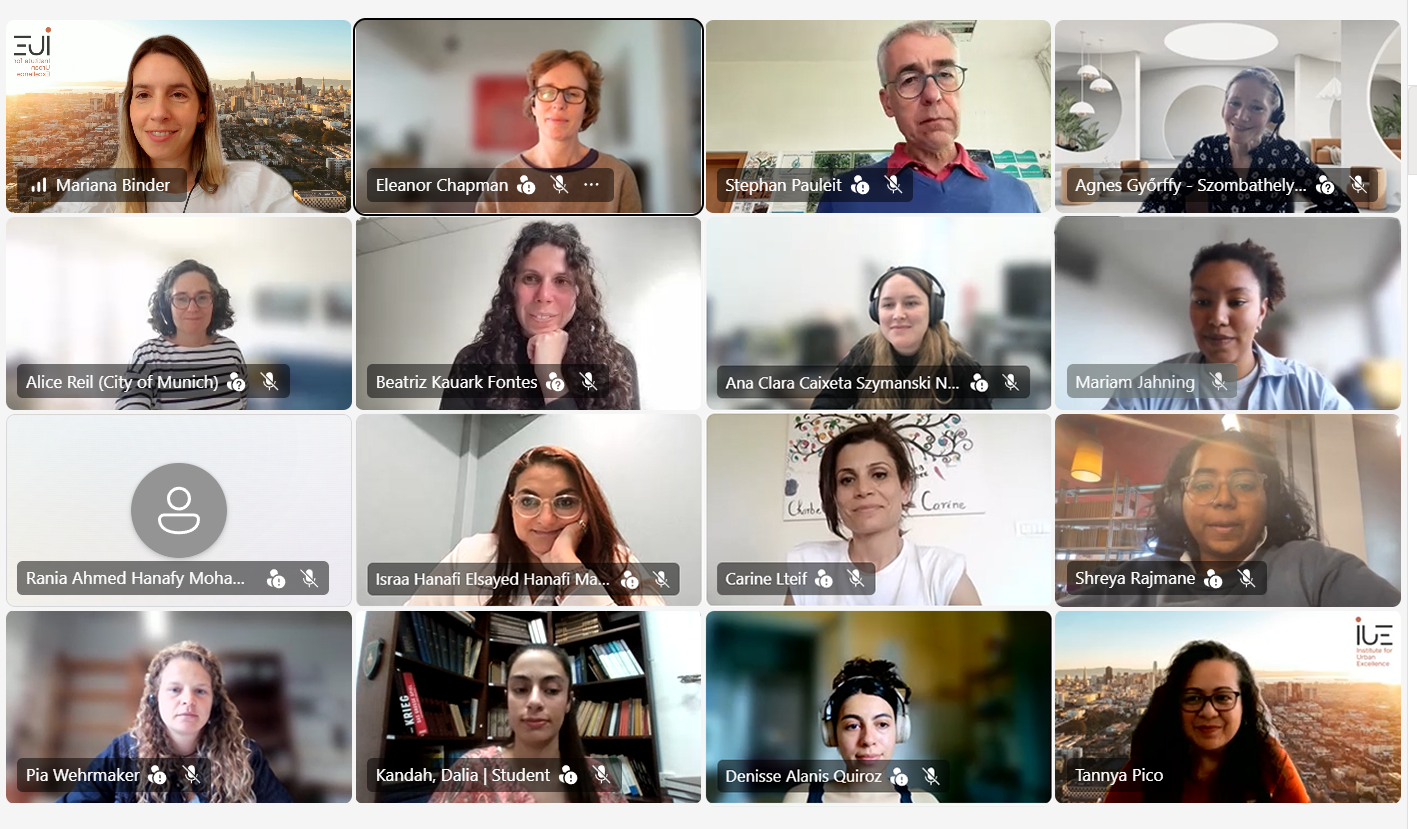
The Institute for Urban Excellence (iUE) developed a new webinar in collaboration with the Technical University of Munich, building on our experiences deploying Nature-based Solutions as part of the JUSTNature project, funded by the Horizon 2020 programme. The training, held on June 10th 2026, explored what collaborative, equitable governance means in urban greening interventions. It counted with insights from local project coordinators from the cities of Munich and Szombathely, and introduced the Co-Greening Handbook, a practical resource with guidance and tools designed to help practitioners and researchers move beyond passive participation toward more inclusive efforts that actively engage vulnerable and minority groups.
Attendees were welcomed by Mariana Binder, Senior Project Officer at iUE. In her opening speech, she introduced the webinar’s topic and the Co-Greening Handbook, explaining how this resource was one of the outputs of JUSTNature, a European project funded by the Horizon 2020 programme, in which iUE, the Technical University of Munich (TUM), and the cities of Munich and Szombathely all participated. Binder outlined the webinar’s agenda and presented the session’s speakers: Eleanor Chapman (TUM), Dr. Beatriz Kauark-Fontes (TUM & University of Kassel), Alice Reil (City of Munich) and Ágnes Győrffy (City of Szombathely).
Eleanor Chapman then took the floor. She briefly explained the purpose and research focus of JUSTNature and introduced the project’s City Practice Labs (CiPeLs): seven locations where green interventions were planned and co-created with local stakeholders. She also presented the Co-Greening Handbook: a toolkit designed to help practitioners and researchers understand, plan and implement green interventions that respond to local needs, engage with local communities and ultimately address environmental justice matters. For this purpose, Chapman discussed some key concepts: collaborative governance and environmental justice, both in the context of urban greening interventions. She highlighted the importance of people-centred approaches in these types of projects, needed to ensure that greening projects are more equitable.
The Co-Greening Handbook was then presented in detail. Beatriz Kauark-Fontes went through the first part: Understanding Just Collaborative Governance. For this, she showed an interactive online version of the handbook, guiding attendees through the various sections and elements. Part 1 included a definition of the concept of co-governance and insights into who to engage in these collaborative processes. In part 2, Setting Up your Collaborative Environment, focus was put on how to identify key actors and how to engage with them (building collaborations, establishing working teams, engaging external actors and reaching out to local communities). At this point, Ágnes Győrffy, JUSTNature local coordinator in the city of Szombathely, took the floor. Győrffy shared insights into the citizen engagement process in the two JUSTNature intervention sites in the Hungarian city. She explained the differences the local team faced when setting up the co-creation process at a local neighbourhood park and in the schoolyard, highlighting how engaging with kids differed from engaging with adults, and shared the challenges and strategies used to strengthen the collaborative process.
The handbook’s third part, Developing a Roadmap towards Just Collaborative Governance, was then discussed. For this, Chapman explored the concept of Theory of Change and its five key components, and explained how it can be used to inform a co-creation methodology. Based on this, she outlined the different steps needed to develop a change pathway and to plan a roadmap towards co-creating urban greening interventions.
Chapman then introduced the handbook’s fourth part: Implementing your Roadmap. In general terms, she outlined three main steps, involving (1) spatial planning and co-design, (2) building and planting, and (3) management. In doing so, she emphasised the importance of setting up clear mechanisms for feedback collection and data management. To provide a real-world experience from practice, Alice Reil (JUSTNature local coordinator) shared insights from the co-creation process in the city of Munich, particularly in the case of activating a schoolyard with primary and secondary school students. Reil explained how the process of setting clear objectives unfolded for them, defining specific desired outcomes and then working back to the actions needed to achieve them.
At this point, Győrffy also shared more about the Szombathely experience, focusing particularly on the challenges that long-term engagement and maintenance pose for these interventions. Adapting to unexpected situations and not being afraid of trying out new, innovative approaches were deemed essential for her, proving that flexibility can be the key for a successful, impactful project.
The webinar concluded with a Q&A section, during which the audience and the speakers had inspiring conversations about the importance of people-centred approaches, the communication challenges that may arise between different actors involved in the interventions and the diverse terminologies and languages they use (academics, city practitioners, children, adult citizens), moving from abstract concepts to on-the-ground interventions, building ownership of green projects and gaining the trust of diverse communities.
Binder wrapped up by thanking all speakers and participants, and by encouraging them to make use of the publicly available Co-Greening Handbook, hoping to advance greener, more inclusive and just urban spaces. All in all, the webinar underscored the importance of moving beyond passive participation towards more inclusive efforts that actively engage vulnerable and minority groups, while addressing the power dynamics that shape who gets a voice in urban greening processes.