New European Soil Monitoring Law
Our reflections
News from Europe: on 26 November 2025, the first ever Soil Monitoring Law was published in the Official Journal of the European Union (OJEU), marking the end of legislative process, and turning the proposed directive into applicable law. It is the first piece of international law aiming to protect soil health, with binding provisions for the 27 Member States of the European Union. Why is it important for spatial planning?
First and foremost, it gives a clear signal to planning practitioners that the UE’s No Net Land Take objective set out in the EU Soil Strategy for 2030 is here to stay, and planning, as the activity that organises land use and functions, will have to adapt.
The legislator presents the process of land take as follows in recital 37:
Finding a common understanding for the different processes behind land take was one of the stumbling blocks for the lengthy negotiation process that led to the adoption of this piece of legislation.
New planning conditions
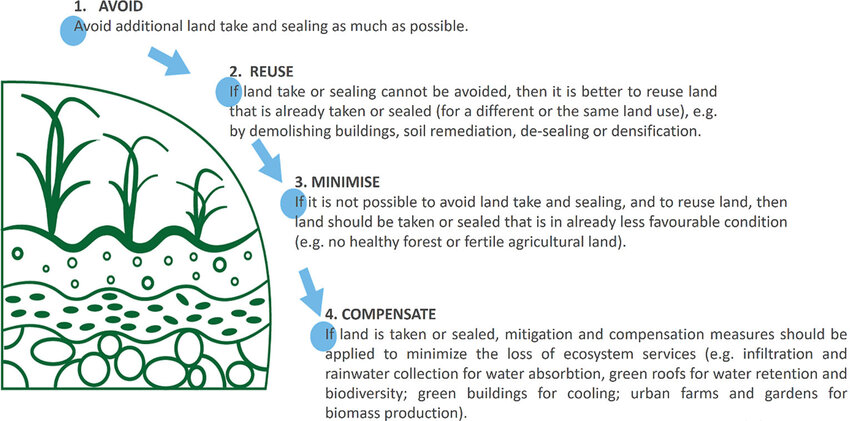
Member States have five years from the directive’s date of entry into force to adopt sustainable soil management practices (e.g. by end 2030), in line with the land take mitigation principles set out in Article 12, following the land take hierarchy.
This new European directive also sets standards (Articles 6 to 9) for data on soil health, which can help inform land-use decision, and help planners respect the land take hierarchy.
While the directive only applies within the EU, it can be expected that others regions in the world will follow suit, or, at least, that is what the EU institutions expect from the block Environmental Leadership at the international level.
iUE is already doing the ground work!
In the introductory recitals (non-binding provisions of a EU legislation), the legislator especially calls on efforts to be based on “a large set of good practices aimed at minimising and offsetting the loss of soil’s capacity to provide ecosystem services.” (recital 42).
The Institute for Urban Excellence is proud to report that, as part of SPADES, we are currently working on the realisation of portfolios of best practices to help spatial planners contribute to soil health!